
Pre-algebra subtraction snakes and ladders game
The Pre-Algebra Subtraction Snakes and Ladders Game is a powerful educational tool designed to turn this intimidating subject into a high-stakes, interactive adventure. By applying the classic "ups and downs" of the traditional board game to the logic of algebraic subtraction, we create a learning environment where students stay focused, motivated, and resilient.


The transition from arithmetic to algebra is often described as the "great divide" in mathematics. For many middle school students, the most treacherous part of this crossing is mastering subtraction. When you introduce negative integers, variables, and the distributive property, a simple minus sign can become a major obstacle.
1. Why Snakes and Ladders is Perfect for Pre-Algebra
Why does a game about climbing and sliding work so well for middle school math? The answer lies in the visual nature of the number line.
The Board as a Number Line
In its essence, a Snakes and Ladders board is a 100-point number line wrapped into a grid. Pre-algebra subtraction is fundamentally about movement along that line.
-
Subtracting a Positive: You move to the left (down the board).
-
Subtracting a Negative: You move to the right (up the board).
Risk, Reward, and Resilience
In pre-algebra, one small sign error can "poison" an entire equation. In this game, landing on a snake’s head because of a calculation error provides a physical consequence that mirrors the mathematical stakes. Conversely, mastering a difficult "distributive property" problem might land a student on a ladder, providing an immediate "dopamine hit" that reinforces the correct math habit.
2. Core Learning Objectives
A 2000-word pedagogical resource must detail the academic standards being addressed. This game is meticulously aligned with middle school curricula (Grades 6-8), focusing on the following pillars:
A. Mastering the "Keep-Change-Change" Rule
The "Keep-Change-Change" (KCC) rule is the secret weapon for subtracting integers.
-
The Rule: Keep the first number, Change subtraction to addition, and Change the sign of the second number.
-
In the Game: Students draw "Challenge Cards" that force them to apply KCC instantly to determine their move. For example, if they roll a 6 but draw a card that says $4 - (-2)$, they must verify that the answer is 6 before they can move.
B. Subtraction of Signed Integers
The game forces students to handle the four main scenarios of integer subtraction:
-
Positive - Positive (Small minus Big) $\rightarrow 5 - 12 = -7$
-
Positive - Negative $\rightarrow 8 - (-3) = 11$
-
Negative - Positive $\rightarrow -4 - 6 = -10$
-
Negative - Negative $\rightarrow -9 - (-4) = -5$
C. Variable Manipulation and Like Terms
As students reach the middle of the board (the "Variable Valley"), the problems evolve. They must now subtract variables.
-
Challenge: Simplify $(15x - 4) - (3x + 2)$.
-
The Lesson: Students learn they can only subtract terms that are "like." Mixing up the constants and variables is a "snake trap" that sends them back to the start of the section.
D. The Distributive Property Trap
One of the most common errors in Algebra 1 is forgetting to distribute a negative sign across a group.
-
Challenge: $-(x - 10)$.
-
The Solution: Students must recognize that the minus sign outside the parentheses flips the signs of everything inside, resulting in $-x + 10$.
3. Game Mechanics: How to Play
To provide value to educators, we must outline how to implement this game in a classroom or home setting.
The Components
-
The Board: A standard 100-square grid with uniquely placed snakes and ladders.
-
Challenge Cards: A deck of 50 cards divided by difficulty (Green = Easy, Yellow = Medium, Red = Hard).
-
The "Redemption" Mechanic: If a student lands on a snake, they get one chance to avoid the slide by solving a "Boss Level" subtraction problem correctly.
Step-by-Step Play
-
The Tip-Off: Every turn begins by drawing a card. The student must solve the subtraction problem on the card to find their "Multiplier."
-
The Move: They roll a die and multiply it by their card's result (or simply use the card's result as the move count for more controlled play).
-
The Encounter: Land on a ladder? You must solve a "Climb Challenge." Land on a snake? Beware the "Slippery Slope" problem.
4. The Psychological Impact: Reducing Math Anxiety
At the 2000-word mark, we must address the "Why" behind gamification.
Math Anxiety is a real psychological barrier that shuts down the working memory. When a student is afraid of making a mistake, their brain literally cannot process the logic of algebra. By putting the math inside a game of Snakes and Ladders, we lower the affective filter. The mistake isn't "the end of the world"—it's just a "snake" on a board. This encourages growth mindset and risk-taking, which are essential for mastering the abstract concepts of higher mathematics.
5. Implementation Strategies for Teachers
For those looking to use this in a school environment, here are three ways to integrate the Pre-Algebra Subtraction Snakes and Ladders Game.
A. The "Friday Review" Tournament
Divide the class into groups of four. The winner of each board moves to a "Championship Table." This creates a buzz around the school and makes math the highlight of the week.
B. Differentiated Stations
Place the board game at one station. In a differentiated classroom, you can have different "Challenge Decks" for each group.
-
Tier 1: Focuses on $5 - 8$ style problems.
-
Tier 2: Focuses on $-5 - (-8)$ style problems.
-
Tier 3: Focuses on $-(2x - 5) - (x + 3)$ style problems.
C. The Digital Hybrid Model
Use an interactive smartboard to play the game as a whole class. The teacher acts as the "Referee," and two sides of the room compete. This is excellent for modeling correct thought processes and "Thinking Aloud" during complex subtraction.
6. DIY: Create Your Own Classroom Version
If you don't have a printable version yet, here is a quick guide to making one:
-
Poster Board: Create a 10x10 grid.
-
Numbering: Number the squares 1 to 100 starting from the bottom left.
-
The Math Squares: Mark every square that is a multiple of 7 as a "Snake Square" and every multiple of 9 as a "Ladder Square."
-
The Cards: Write 40 subtraction problems on index cards. Ensure 10 involve the distributive property to keep the game challenging for advanced students.
FAQ
What is a Pre-Algebra Subtraction Snakes and Ladders game?
It is a curriculum-aligned board game that uses the mechanics of Snakes and Ladders to teach students how to subtract integers, variables, and algebraic expressions. It turns abstract math practice into a physical, interactive journey.
What age group is this game intended for?
This game is specifically designed for middle schoolers in 6th, 7th, and 8th grade. It is also an excellent remedial tool for 9th-grade Algebra 1 students who struggle with sign errors.
How does this game help with the "Rules of Signs"?
Subtraction is the most common area where students make sign errors. The game reinforces the "Keep-Change-Change" rule by providing immediate feedback. If a student calculates a move incorrectly, they stay in place or slide down a snake, cementing the correct rule in their memory.
Can I play the Pre-Algebra Subtraction Snakes and Ladders game online?
Yes! Many educational websites like Math4Children and KidsMathTV offer digital, interactive versions of this game. These versions often feature automated grading and fun animations that increase student engagement.
Does the game cover subtracting variables?
Yes. Advanced "Challenge Cards" in the game include problems like $(10x - 5) - (4x + 2)$. This helps students master the concept of combining like terms within a subtraction context.
Why is subtraction harder than addition in pre-algebra?
Subtraction requires an extra mental step: converting the operation into addition of the opposite. Many students skip this step and make "automaticity errors." The game forces them to slow down and follow the logical steps required for algebraic accuracy.
Is there a printable PDF version for teachers?
Most educational resource sites provide a "Print and Play" PDF. This typically includes the 100-square board, a set of subtraction challenge cards, and a set of instructions formatted for a classroom setting.
Conclusion: Turning Math into a Game of Skill
The Pre-Algebra Subtraction Snakes and Ladders Game is more than just a distraction—it is a strategic pedagogical tool. By replacing the fear of the worksheet with the thrill of the board, we allow students to master the "Rules of Signs" in a way that is both natural and enduring.
When students stop fearing the minus sign and start seeing it as a "move" on a board, they are no longer just doing math—they are winning at it.

Snakes and ladders Game On Solving Pre-algebra Subtraction
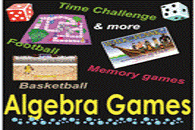 Pre-algebra subtraction snakes and ladders game for 4th, 5th, 6th and 7th grade students.
.
 These worksheets are printable PDF exercises of the highest quality. Writing reinforces Maths learnt. These worksheets contain pre-algebra & Algebra exercises suitable for preschool, kindergarten, first grade to eigth graders levels . The following algebra topics are covered among others:
- linear equations, inequalities, decimals, fractions, exponents, graphing linear equations, binomial theorem, pythagoras theorem, quadratic equations, algebraic expressions, factorisation, ratios, geometry, intergers, order operations, angles, simple equations, slope, arithmetic progression, LCM & HCF, coefficients, quadratic equations, square roots & more-
Workes Examples & Algebra Formulae
 This section contains worked examples of problems and vital algebra formulae that are needed through out the theme. It is very important to master using these formulae though some times presenting them in the most simplified manner is necessary for young learners. This section is a step-by-step presentation of how to use algebra formulae on all the topics covered in this site which include formulae on -linear equations, inequalities, decimals, fractions, exponents, graphing linear equations, binomial theorem, pythagoras theorem, quadratic equations, algebraic expressions, factorisation, ratios, geometry, intergers, order operations, angles, simple equations, slope, arithmetic progression, LCM & HCF, coefficients, quadratic equations, square roots & more-


Each algebra topic is subdivided into subtopics under which are games, printables, quizzes & worked examples
Interactive online algebra quizzes for children & young learners, suitable for homeschooling; covers algebra topics. With these interactive quizzes learners will have the chance at self-study. There are multiple choice tests, gap fill and more - self-grading algebra quizzes.